









How to Use a Real Estate Agent Practice Test to Pass on Your First Try
Passing the real estate licensing exam is the final gatekeeper to starting your new career, and it can be intimidating. The key to walking into the testing center with confidence isn't just memorizing facts; it's about understanding how to apply them under pressure. This is where a high-quality real estate agent practice test becomes your most valuable study tool, helping you simulate the real exam environment and pinpoint exactly where you need to focus your efforts.
This guide will walk you through everything you need to know about using practice exams to your advantage. We'll cover how to choose the right one, what features to look for, and a step-by-step strategy to turn practice questions into a passing score. Your journey to becoming a licensed agent starts with smart preparation.
What You'll Learn
- The Purpose of Practice Tests: A real estate practice test is more than a quiz; it's a diagnostic tool designed to mimic the format, timing, and difficulty of the official state and national exams.
- Key Benefits: Using an agent practice exam helps build confidence, identify knowledge gaps, improve time management, and significantly reduce test-day anxiety.
- How to Choose a Provider: Look for platforms that offer both national and state-specific questions, provide detailed answer explanations, and have positive user reviews.
- Effective Study Strategy: The best approach involves taking a baseline test, analyzing your results to find weak areas, focusing your study on those topics, and simulating real exam conditions.
- Free vs. Paid Options: While free quizzes are great for a quick check, paid platforms typically offer more comprehensive question banks, performance analytics, and realistic simulations.
What Exactly Is a Real Estate Agent Practice Test?
A real estate agent practice test is a preparatory exam designed to simulate the actual licensing test you'll need to pass to become a real estate agent. It's not just a simple real estate quiz; it's a carefully constructed tool that mirrors the structure, question types, and time constraints of the official examination. These tests cover the same core subjects, including property ownership, contracts, financing, agency law, and state-specific regulations.
The primary goal is to give you a realistic preview of what to expect on exam day. By taking a practice version, you can assess your current knowledge level and identify your strengths and weaknesses long before you sit for the real thing. This diagnostic function is crucial because it allows you to tailor your study plan to focus on the areas where you need the most improvement, rather than wasting time on concepts you've already mastered.
Furthermore, these practice exams help you get comfortable with the format. Most licensing exams are multiple-choice and timed, which can be a stressful combination. Regularly using a practice test helps you develop a rhythm for answering questions efficiently and managing your time effectively, ensuring you don't run out of time on the actual test.
Key Features and Benefits of Using an Agent Practice Exam

Integrating an agent practice exam into your study routine offers numerous advantages that go far beyond simple memorization. The features built into quality test prep platforms are designed to create a comprehensive learning experience that directly translates to a better score.
One of the most significant benefits is identifying knowledge gaps. It’s easy to feel confident after reading a textbook, but a practice test reveals what you actually know. When you consistently get questions wrong in a specific area, like contracts or real estate math, you know exactly where to focus your study time. This targeted approach is far more efficient than re-reading entire chapters.



Another key feature is realistic simulation. The best practice tests mimic the timing and pressure of the real exam. Learning to answer 100-150 questions within a few hours is a skill in itself. This practice builds mental stamina and teaches you how to pace yourself, so you don’t spend too much time on difficult questions at the expense of easier ones.
Detailed answer explanations are perhaps the most valuable feature. A good practice test doesn't just tell you that your answer was wrong; it explains why it was wrong and why the correct answer is right. This turns every mistake into a learning opportunity, deepening your understanding of the underlying concepts. This is critical for mastering the nuances of real estate law and principles.
Finally, the consistent use of a real estate quiz builds immense confidence. Walking into the exam room feeling prepared and familiar with the format drastically reduces test anxiety. When you've successfully answered hundreds of similar questions before, the real exam feels less like a daunting obstacle and more like the final step in a process you've already mastered.

How to Choose the Right Real Estate Test Prep Platform
With so many options available online, selecting the right real estate agent practice test provider can feel overwhelming. Not all platforms are created equal, and the quality of your study materials can directly impact your success. Follow these steps to choose a resource that will genuinely prepare you for your exam.
First, verify that the provider offers both national and state-specific content. The real estate exam is divided into two parts: a national portion covering general principles and a state portion covering local laws and regulations. A practice tool that only covers the national section leaves you unprepared for half of the test. Look for providers that explicitly offer materials for your specific state.
Second, evaluate the quality and quantity of the questions. A large question bank is good, but the quality is more important. The questions should be challenging and reflect the style of the actual exam. Read reviews from other students to see if they found the practice questions to be a good representation of the real test.
A platform with thousands of questions ensures you won't see the same ones repeatedly.
Third, insist on detailed answer explanations. As mentioned, this is non-negotiable. If a platform marks an answer wrong without explaining the reasoning, it offers very little educational value. The best services provide clear, concise explanations for every single question, often referencing the specific law or principle involved.
Lastly, consider the user interface and features. Is the platform easy to navigate. Does it offer different modes, like timed exams and topic-specific quizzes. Does it provide performance analytics to track your progress over time.
A user-friendly dashboard that shows your scores by topic can be an invaluable tool for guiding your studies.
Pro Tip: Many top-tier providers offer a free trial or a limited number of free practice questions. Always take advantage of these offers to test the platform's interface and question quality before committing to a paid plan.
Comparing Key Features in Practice Test Platforms
To help you decide, here’s a look at what to compare when evaluating different options. Look for a balance of features that fits your learning style and budget.
| Feature | What to Look For | Why It Matters |
|---|---|---|
| State-Specific Content | Explicit coverage for your state | State laws make up a significant portion of the exam; general knowledge isn't enough. |
| Question Bank Size | 1,000+ questions | A large bank prevents repetition and ensures comprehensive coverage of all topics. |
| Answer Explanations | Detailed rationale for every answer | This is how you learn from your mistakes and deepen your understanding. |
| Exam Simulation | Timed, full-length practice exams | Builds mental stamina and helps you master time management under pressure. |
| Performance Analytics | Score tracking by topic area | Allows you to identify and focus on your weakest subjects for efficient studying. |
| User Reviews | Feedback from recent test-takers | Provides real-world insight into how well the material prepares students for the actual exam. |
Top Real Estate Practice Test Providers in 2026
While we don't endorse any single provider, certain names consistently receive positive feedback from aspiring agents. These platforms are known for their comprehensive materials and effective preparation tools. Here are a few highly-regarded options to consider in your research.
1. PrepAgent
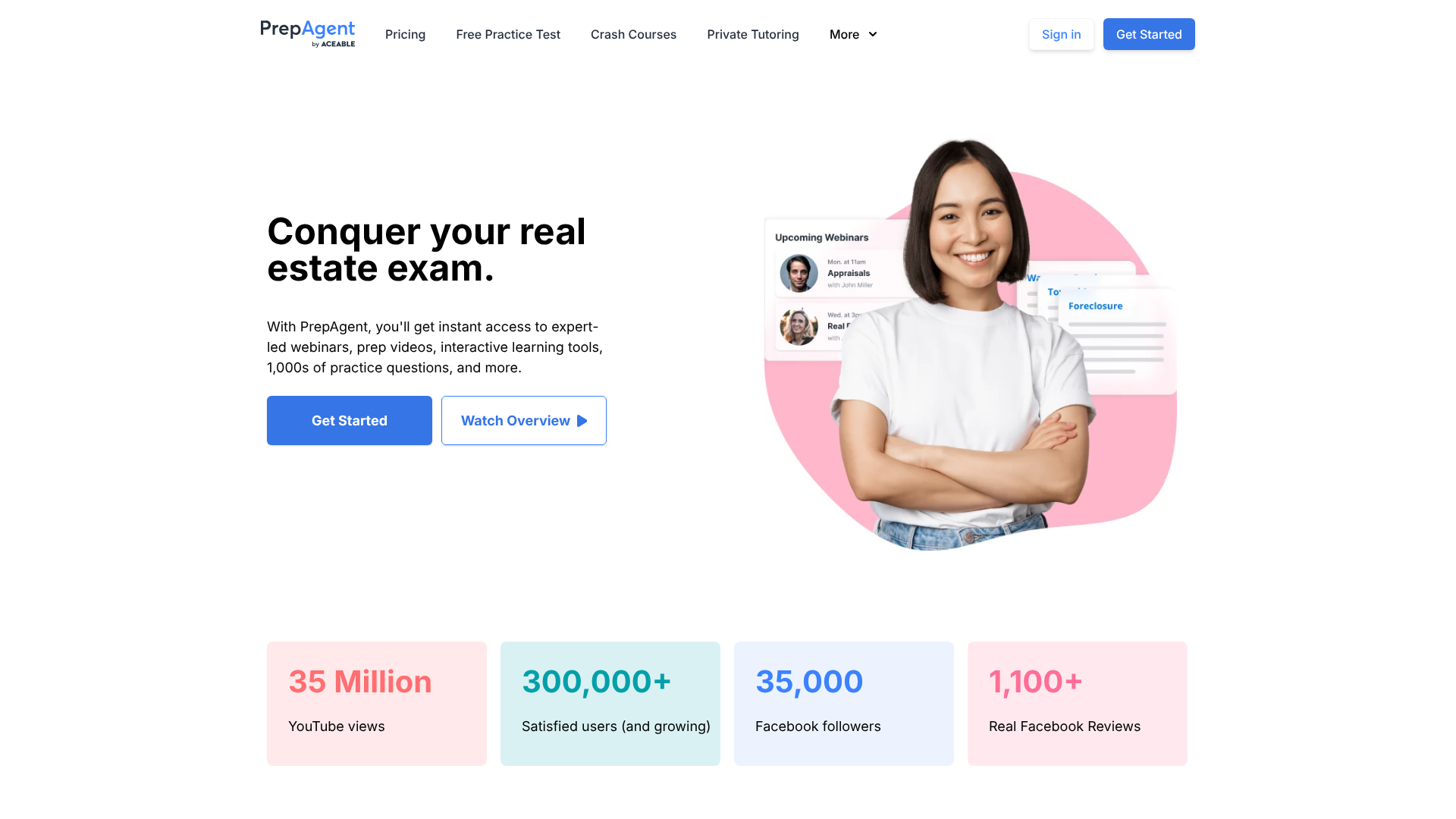
PrepAgent is one of the most popular and frequently recommended resources in the real estate education space. It's known for its engaging teaching style, which includes live webinars, video explanations, and an extensive library of practice questions.
Pros:
- Offers materials for all 50 states.
- Provides thousands of practice questions with detailed explanations.
- Includes interactive features like live online webinars and a vast video library.
- Multiple pricing tiers to fit different budgets and study timelines.
Cons:
- The subscription model may be more expensive than a one-time purchase if you need extended access.
- The wealth of resources can feel overwhelming to some users initially.
2. Kaplan Real Estate Education (KapRE)
Kaplan is a giant in the test prep industry, and its real estate division is no exception. They offer a structured, academic approach to exam prep, which is ideal for students who prefer a more traditional learning environment.
Pros:
- A well-established and reputable name in education.
- Offers a variety of study packages, including live classes, on-demand video courses, and practice question banks.
- The curriculum is thorough and professionally designed.
- Provides both national and state-specific exam prep.
Cons:
- Can be one of the more expensive options on the market.
- Some users find the material to be dense and less engaging than other platforms.
3. The CE Shop
The CE Shop is another top-tier provider that offers pre-licensing education and exam prep. Their platform is modern, mobile-friendly, and designed for self-paced learning. They boast a high pass rate among their students.
Pros:
- Modern, intuitive, and mobile-friendly user interface.
- Reports a high national pass rate, suggesting effective materials.
- Offers tiered packages that bundle pre-licensing courses with exam prep.
- Strong focus on state-specific content.
Cons:
- Exam prep is often sold as part of a larger, more expensive pre-licensing package.
- May have fewer interactive features like live webinars compared to PrepAgent.
A Practical Guide: How to Maximize Your Study Sessions
Simply having access to a great real estate agent practice test isn't enough. You need a strategy to use it effectively. Follow this step-by-step process to transform your practice sessions into real, measurable progress.
Step 1: Take a Baseline Diagnostic Test
Before you begin studying, take a full-length practice exam under timed conditions. Don't worry about your score; the purpose of this first test is to establish a baseline. It will give you an unbiased look at your current knowledge and highlight the topics you need to work on the most. Treat it like the real thing: no notes, no distractions, and stick to the time limit.
Step 2: Analyze Your Results Thoroughly
Once you have your score, dive deep into the results. Don't just look at the overall percentage. Analyze the breakdown by category. Did you ace the questions on contracts but struggle with property valuation.
Were you consistently tripped up by real estate math.
Your goal is to identify patterns. Create a list of your 2-3 weakest subject areas. This is where you will concentrate the majority of your study efforts. This targeted approach is far more effective than passively re-reading all the material.
Step 3: Focus Your Study on Weak Areas
With your weak areas identified, go back to your pre-licensing course materials, textbooks, or videos and focus exclusively on those topics. If you struggled with financing, spend a few days mastering concepts like mortgages, interest rates, and loan types. After you feel more confident, take topic-specific quizzes on just that subject to reinforce your learning.
Step 4: Simulate Real Exam Conditions
As your exam date gets closer, shift your focus to taking full-length, timed practice exams. This builds the mental endurance needed for the actual test. Find a quiet space, put your phone away, and set a timer. The more you can replicate the official testing environment, the more comfortable and less anxious you will feel on the big day.
For a better understanding of the types of questions you'll face, this video provides an excellent walkthrough of 75 common exam questions and answers.
Step 5: Review Every Question—Especially the Wrong Ones
After each practice exam, spend as much time reviewing your answers as you did taking the test. For every question you got wrong, read the explanation until you understand why you made the mistake. But don't stop there. Also, review the questions you got right.
This helps confirm that you answered correctly for the right reasons and weren't just guessing. This final step solidifies your knowledge and builds lasting confidence.
Decoding the Costs: Free vs. Paid Practice Exams
When you start searching for a real estate test, you'll find a mix of free and paid options. It's important to understand the differences between them to decide how to best allocate your resources.
Free practice quizzes are widely available and can be a great starting point. They are perfect for getting a quick snapshot of your knowledge or for drilling a specific topic. Many reputable real estate schools offer a short, free real estate quiz on their websites as a way to attract potential students. These are excellent for supplementary practice.
However, free resources often have limitations. They may have a small pool of questions, meaning you'll see repeats quickly. They might not cover state-specific material, and they almost never offer the detailed analytics and performance tracking that are crucial for a targeted study plan. Think of them as flashcards—good for quick reviews, but not a complete study system.
Paid practice exam platforms, on the other hand, are comprehensive study solutions. For a fee—which can range from a one-time purchase of around $50 to a monthly subscription of $40-$100—you get access to a massive question bank, full-length exam simulations, detailed answer explanations, and progress tracking. This investment is often worth it because it provides the structure and depth needed to prepare thoroughly.
Pro Tip: Consider a paid service as an investment in your career. The cost is minimal compared to the cost and frustration of having to retake the exam. A high-quality prep course can significantly increase your chances of passing on the first attempt.
The Pros and Cons of Relying on Practice Quizzes
While practice tests are an indispensable tool, it's important to have a balanced perspective. They should be one component of a larger study strategy, not your only resource.
Pros
- Active Recall: Practice tests force you to actively retrieve information from your brain, which is a much more effective learning method than passive reading.
- Performance Simulation: They are the best way to get comfortable with the time pressure and format of the real exam.
- Efficient Studying: Analytics help you pinpoint and focus on your specific weak areas, saving you valuable study time.
- Confidence Booster: Consistently scoring well on practice exams is one of the best ways to reduce test-day anxiety and build confidence.
Cons
- Risk of Memorization: If a question bank is too small, you might start memorizing the answers to specific questions rather than learning the underlying concepts.
- False Sense of Security: Scoring well on one provider's easy tests might not mean you're ready for the real thing. It's crucial to use high-quality, challenging materials.
- Not a Substitute for Foundational Knowledge: Practice tests are for assessment and reinforcement. They cannot replace the initial learning that comes from your pre-licensing coursework.
Frequently Asked Questions (FAQ)
Here are answers to some of the most common questions aspiring agents have about the real estate exam and how to prepare for it.
How many questions are on the real estate exam?
The total number of questions varies by state, but most exams consist of 100 to 150 multiple-choice questions. This is typically split into a national portion (around 80-100 questions) and a state-specific portion (around 30-50 questions). You will need to check with your state's real estate commission for the exact number of questions and the time allotted. For example, California has 150 questions, while Texas has 110.
Is the real estate exam hard to pass?
The difficulty of the real estate exam is subjective, but it is challenging and requires dedicated preparation. National pass rates typically hover between 50% and 60% for first-time takers, which indicates that many people underestimate the amount of study required. The exam covers a broad range of topics, from complex legal principles to detailed financial calculations. Success is less about intelligence and more about diligent, structured studying, which is why practice tests are so critical.
What is a passing score for the real estate exam?
A passing score, or "cut score," is determined by each state's licensing authority. The most common passing score is between 70% and 75%. This means you must answer at least 70% or 75% of the questions correctly to pass. It's important to note that you usually must pass both the national and state-specific sections independently.
You can find your state's exact requirement on its official real estate commission website. According to ARELLO, the Association of Real Estate License Law Officials, each jurisdiction sets its own standards.
Can you use a calculator on the real estate test?
Yes, you are typically allowed to use a basic, non-programmable calculator for the real estate exam. The test includes a section with real estate math problems, which may involve calculating commissions, property taxes, loan amortization, or property area. The testing center will provide a calculator or approve the one you bring. You are not allowed to use a calculator on your phone or any other smart device.
Final Thoughts
Passing your real estate exam is a significant milestone, and the right preparation can make all the difference. A real estate agent practice test is not just a study aid; it's a strategic tool that empowers you to study smarter, not just harder. By simulating the real exam, identifying your weaknesses, and building your confidence, you can walk into the testing center fully prepared to succeed.
Remember to choose a high-quality platform that offers both national and state-specific questions with detailed explanations. Follow a structured study plan that starts with a diagnostic test and focuses on improving your weak areas. By combining your pre-licensing coursework with diligent practice, you'll be well on your way to earning your license and launching a successful career in real estate.