









How to Use a Real Estate Agent Practice Test to Pass on Your First Try
Passing your real estate licensing exam is the critical first step toward a rewarding career. The path to getting licensed can feel overwhelming, but a structured study plan is your best tool for success. At the core of any effective plan is the strategic use of a real estate agent practice test. These exams do more than just quiz you; they simulate the real testing environment, reveal your knowledge gaps, and build the confidence you need to walk into the testing center fully prepared.
This guide will walk you through everything you need to know to ace your exam. We'll cover the core concepts tested, legal and ethical standards, and proven study strategies. Think of this as your roadmap from pre-licensing coursework to celebrating your new license.
What You'll Learn
- Why Practice Tests Are Essential: Discover how using an
agent practice examis the most effective way to identify your weak spots and get comfortable with the test format before the big day. - The Core Knowledge Areas: Get a clear overview of the key topics covered on the national portion of the exam, from property law and contracts to financing and valuation.
- Critical Legal and Ethical Principles: Understand the non-negotiable rules you must master, including fiduciary duties and Fair Housing laws, which are heavily weighted on the test.
- Effective Study Strategies: Learn actionable tips to maximize your study time, improve information retention, and build the confidence needed to pass on your first attempt.
First, Understand Your State's Licensing Requirements
Before you dive into real estate exam prep, you must understand the specific rules for your state. Real estate is regulated at the state level, meaning the journey to becoming a licensed agent varies depending on where you plan to work. These differences can be significant, so this is always your starting point.
Generally, most states require you to:
-
Be a certain age (typically 18 or 19). * Be a legal resident of the United States. * Complete a specific number of pre-licensing education hours from an approved school. * Pass a state-specific and national real estate exam.
-
Pass a criminal background check.
The number of required education hours can range from as low as 40 to over 180. These courses cover foundational knowledge that will appear on your real estate test. The best first step is to visit your state's official real estate commission website. This government resource provides the most accurate and up-to-date information on requirements, approved schools, and exam registration.
For example, the California Department of Real Estate outlines all necessary steps for aspiring agents in that state.
Mastering Key Concepts in Real Estate Transactions
The real estate exam is designed to ensure you have the fundamental knowledge to guide clients through complex transactions legally and ethically. While the questions can be tricky, they are based on a core set of concepts that you will master during your studies. A good real estate agent practice test will challenge your understanding of these areas.
The Lifecycle of a Property Sale
You need to understand the entire process from start to finish. This begins with a listing agreement between a seller and a broker. It then moves to marketing the property, receiving and presenting offers, navigating negotiations and counteroffers, and managing contingencies like inspections and financing. The final stages involve the closing process, where title is transferred and the sale is recorded.



Your exam will have questions about the validity and components of each of these steps.
Types of Property Ownership
How a person or entity holds title to a property has significant legal and financial implications. The exam will test your knowledge of different ownership forms. This includes concepts like Tenancy in Common (where co-owners can have unequal shares), Joint Tenancy (which includes the right of survivorship), and Tenancy by the Entirety (a form of ownership for married couples). You should also be familiar with less common forms like ownership within a trust or corporation.
Understanding Contracts and Disclosures
Contracts are the backbone of every real estate deal. You must know the essential elements of a valid contract: offer and acceptance, consideration, competent parties, and legal purpose. The exam will also cover the importance of disclosures. Sellers are often legally required to disclose known material defects about the property, and failure to do so can have serious consequences.
Understanding your role in facilitating these disclosures is critical.
The Art and Science of Property Valuation

Determining a property's value is a cornerstone of the real estate profession. While you won't be a licensed appraiser, you are expected to understand the basic principles of valuation to help clients price their homes for sale or make competitive offers. The real estate test will include questions on the three primary methods of property valuation.
The Sales Comparison Approach
This is the most common method used for residential properties. It involves analyzing recently sold properties (known as "comparables" or "comps") that are similar to the subject property in location, size, condition, and features. Adjustments are made to the comps' sale prices to account for differences. For example, if a comparable has a swimming pool and the subject property doesn't, you would subtract the value of the pool from the comparable's price.
The Cost Approach
This method is most often used for unique properties like schools or churches, or for new construction. It determines value by calculating the cost to replace the building (including materials and labor), subtracting any depreciation, and then adding the value of the land. Depreciation can be physical (wear and tear), functional (outdated design), or external (negative influences from outside the property).
The Income Approach
For investment properties that generate income, like apartment buildings or commercial rentals, the income approach is key. This method values the property based on the net operating income (NOI) it generates. Investors use a capitalization rate ("cap rate") to convert the property's income stream into an estimate of its current market value. A lower cap rate generally implies a higher value and lower risk.
Navigating Legal and Ethical Waters
A significant portion of your agent practice exam will focus on the legal and ethical responsibilities of a real estate agent. These rules are not suggestions; they are strict requirements designed to protect the public. A deep understanding here is non-negotiable for passing the exam and building a trustworthy career.
Fiduciary Duties (OLD CAR)
When you represent a client, you are in a fiduciary relationship, which is a position of special trust and confidence. You owe your client specific duties, often remembered by the acronym OLD CAR:
-
Obedience: You must obey the client's lawful instructions. * Loyalty: You must act solely in the best interest of your client, above all others, including yourself. * Disclosure: You must disclose all material facts to your client.
-
Confidentiality: You must keep your client's confidential information private, even after the transaction closes. * Accounting: You must account for all funds or property entrusted to you. * Reasonable Care: You must use your skills and knowledge with competence and care.
Fair Housing Laws
The federal Fair Housing Act, along with state and local laws, prohibits discrimination in housing-related transactions based on certain protected classes. The seven federally protected classes are race, color, religion, national origin, sex, disability, and familial status. You must know these and any additional classes protected by your state. Actions like steering (guiding clients toward or away from certain neighborhoods based on a protected class) or blockbusting (inducing panic selling) are illegal and heavily tested.
Agency Relationships
Your exam will require you to identify different types of agency relationships. This includes being a seller's agent (representing the seller), a buyer's agent (representing the buyer), or a disclosed dual agent (representing both in the same transaction, which is not legal in all states and requires informed consent). Understanding who you represent and the duties you owe to each party is fundamental.
Pro Tip: Many exam questions are situational. They will describe a scenario and ask you to identify the fiduciary duty that was violated or the correct legal action to take. Practice these types of questions to get comfortable applying the concepts.
Skills Beyond the Books: Communication and Negotiation

While your real estate test will consist of multiple-choice questions, the principles of effective communication and negotiation are woven into the curriculum. The exam is designed to ensure you have the foundational knowledge to perform these tasks professionally. You won't be asked "How do you build rapport?" but you will be tested on the proper procedures for presenting offers and counteroffers, which is a form of structured communication.
For example, a question might ask about the agent's duty when receiving multiple offers on a property. The correct answer will reflect the fiduciary duty of loyalty and disclosure—the agent must present all offers to the seller unless instructed otherwise. This tests your understanding of the correct communication protocol defined by law and ethics.
Similarly, negotiation principles are tested through questions about contracts. Understanding what constitutes a valid offer, how a counteroffer works (it legally rejects the original offer), and the role of contingencies are all part of the negotiation process that you must know for the exam. Your pre-licensing course will teach you the rules that govern these interactions, and your practice exams will help you apply them to specific scenarios.
Preparing for Success: Real Estate Marketing Fundamentals
Once you're a licensed agent, marketing will be a huge part of your business. The licensing exam isn't designed to make you a marketing expert, but it will test your knowledge of the rules and regulations that govern real estate advertising. The goal is to protect consumers from misleading or false claims.
Understanding Permissible Advertising
Your real estate exam prep must include a review of advertising laws. Key topics include:
- Broker Identification: All advertising must clearly and conspicuously include the name of your brokerage firm. You cannot advertise in a way that suggests you are an independent agent. * Truth in Advertising: You cannot make false or misleading statements about a property.
This includes everything from exaggerating the square footage to using photos that misrepresent the property's condition. * Digital and Social Media: The same rules apply to online advertising, including social media posts. Your brokerage affiliation must be clear on your professional profiles.
Introduction to Modern Marketing Tools
While not directly on the test, your pre-licensing courses may touch upon the tools you'll use in your career. After you pass your exam, a Customer Relationship Management (CRM) system is one of the most important investments you'll make. A CRM helps you organize contacts, manage leads, and automate follow-up. Getting familiar with what a CRM does can give you a head start.
For example, a platform like Follow Up Boss is designed specifically for real estate agents to manage their client pipeline from initial contact to closing and beyond.
The Role of Technology in Modern Real Estate Transactions
Technology has transformed the real estate industry, and your licensing exam will reflect this. You are expected to have a basic understanding of the digital tools that facilitate modern transactions. This knowledge ensures you can operate effectively in today's market.
How the Multiple Listing Service (MLS) Works
The MLS is a cooperative database of property listings shared among real estate brokers. It's the primary tool agents use to find properties for buyers and expose listings to other agents. Your exam may have questions about the rules of the MLS, such as the requirement to submit new listings within a certain timeframe and to provide accurate information.
Digital Signatures and Transaction Management
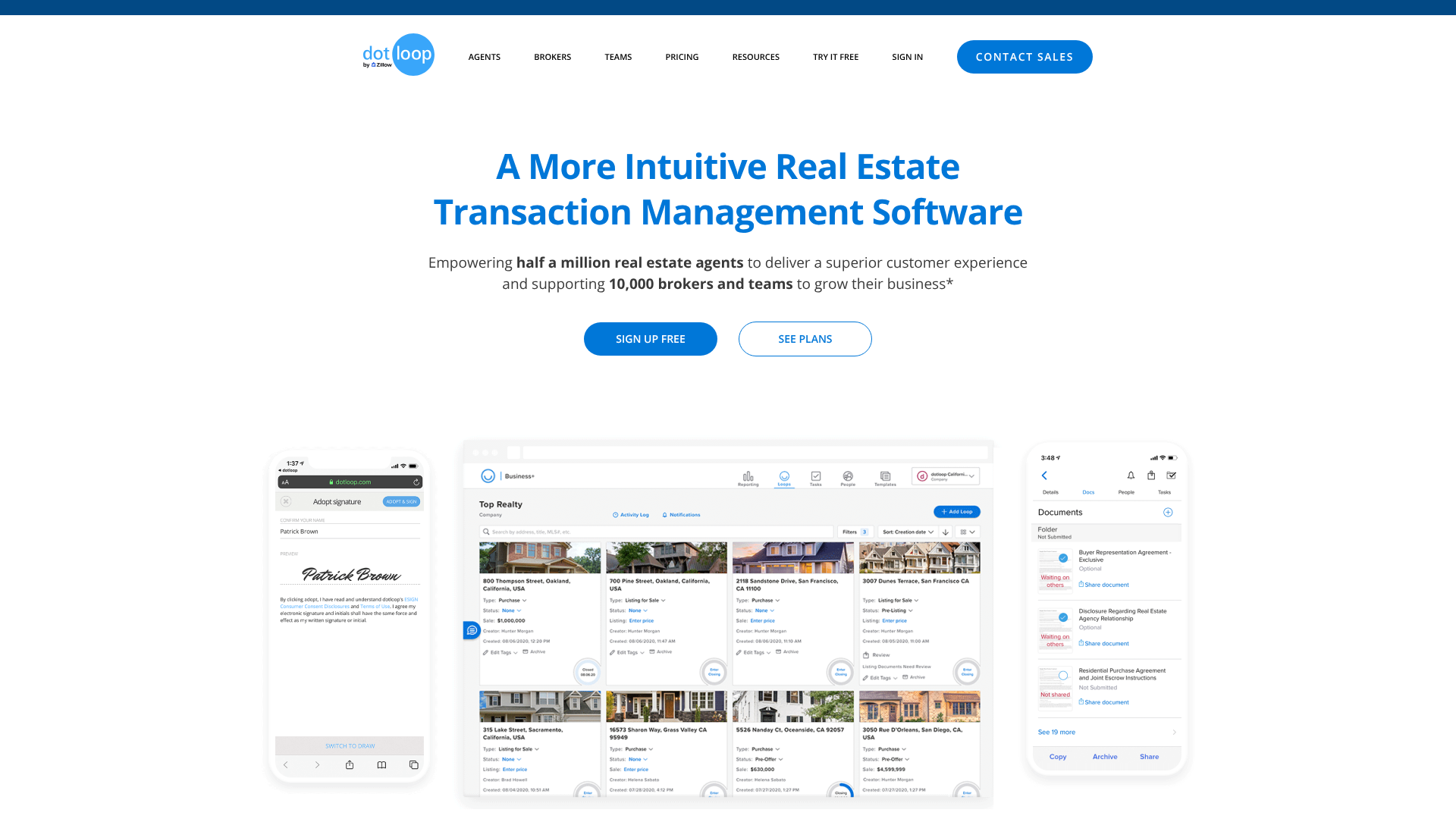
Gone are the days of printing every document for a wet signature. The E-Sign Act and the Uniform Electronic Transactions Act (UETA) give electronic signatures the same legal weight as handwritten ones. You'll need to know the principles behind their validity. In your career, you'll use transaction management software to handle this entire process.
A tool like Dotloop allows agents, clients, and other parties to share, edit, and sign documents in a single online workspace, creating a seamless and efficient workflow from offer to close.
Customer Relationship Management (CRM) Systems
As mentioned in the marketing section, CRMs are vital for managing your business. They are more than just a digital address book. Modern CRMs help you track every interaction with clients, set reminders for follow-ups, and analyze your business to see where your leads are coming from. Understanding the purpose of this technology demonstrates that you are prepared for the business side of being a real estate agent.
A Glossary of Must-Know Real Estate Terms
Your agent practice exam will be filled with industry-specific terminology. If you don't know the vocabulary, you'll struggle to understand the questions. Here are some of the most common terms you absolutely must know.
- Amortization: The process of paying off a loan over time with regular payments that cover both principal and interest.
- Appraisal: An estimate of a property's fair market value, conducted by a licensed appraiser.
- Contingency: A condition in a contract that must be met for the contract to become binding.
- Deed: The legal document that transfers ownership (title) of a property from one person to another.
- Earnest Money: A deposit made by a buyer to a seller to demonstrate good faith in a transaction.
- Easement: The right to use another person's land for a specific purpose (e.g., a utility company's right to access power lines).
- Encroachment: An intrusion on a person's territory or property, such as a fence built over the property line.
- Escrow: An arrangement where a neutral third party holds funds or documents on behalf of the other two parties in a transaction.
- Lien: A legal claim against a property as security for a debt.
- Title Insurance: Insurance that protects the owner and lender against losses resulting from defects in the title.
Put Your Knowledge to the Test: Sample Practice Questions
Reading and studying are important, but nothing prepares you better than actually doing what you'll be doing on test day: answering questions. Taking a real estate agent practice test helps you apply your knowledge, manage your time, and get used to how questions are worded.
This video provides an excellent simulation with 75 questions and answers, covering many of the topics you'll face.
Here are a few sample questions in the style you can expect:
1. An agent lists a property and advertises it as being in the area's best school district. The agent knows this is a popular opinion but hasn't verified the school district boundaries. This is an example of:
a) Puffing
b) Misrepresentation
c) Fraud
d) Good marketing
- Answer: b) Misrepresentation. While puffing involves subjective opinions (e.g., "beautiful home"), stating a property is in a specific school district is a factual claim. If it's false, even if unintentional, it's misrepresentation. Fraud would require intentional deceit.
2. Which of the following is a fiduciary duty owed by an agent to their client?
a) Honesty
b) Fair dealing
c) Loyalty
d) All of the above
- Answer: c) Loyalty. While an agent owes honesty and fair dealing to all parties in a transaction, the fiduciary duty of loyalty is owed exclusively to their client.
3. A homeowner has a mortgage with a fixed interest rate, and their monthly payment of $1,500 includes principal, interest, taxes, and insurance (PITI). This type of loan is known as a(n):
a) Amortized loan
b) Budget mortgage
c) Balloon loan
d) Adjustable-rate mortgage
- Answer: b) Budget mortgage. While the loan is also amortized, the key detail is that the payment includes taxes and insurance held in escrow. This specific arrangement is called a budget mortgage.
4. The federal Fair Housing Act prohibits discrimination based on all of the following EXCEPT:
a) Religion
b) Marital status
c) Familial status
d) National origin
- Answer: b) Marital status. Marital status is not one of the seven federally protected classes. However, it may be a protected class under state or local law, which is why knowing your local regulations is important.
Your Ultimate Study Plan: Tips for Acing the Real Estate Exam
Knowledge is one part of the equation; strategy is the other. How you study for the real estate test can make all the difference. Follow these tips to create an effective study plan that leads to a passing score.
Create a Consistent Study Schedule
Cramming for a few days before the exam is a recipe for failure. The sheer volume of information requires consistent effort over several weeks. Block out specific times in your calendar for studying and stick to them. Treat your study sessions like appointments you can't miss.
Consistency builds long-term memory far better than last-minute panic.
Use the Real Estate Agent Practice Test Strategically
Don't just take practice exams to see if you can pass. Use them as diagnostic tools. After completing an agent practice exam, carefully review every question you got wrong. Don't just look at the right answer; understand why it was right and why your choice was wrong.
This process will reveal your weak areas—whether it's contracts, financing, or property law—so you can focus your study time where it's needed most.
Don't Just Memorize, Understand the "Why"
Pure memorization is fragile. The real exam will present scenarios you haven't seen before, requiring you to apply concepts rather than just recite definitions. For every rule or term you learn, ask yourself why it exists. Why are fiduciary duties so important.
Why do Fair Housing laws have specific protected classes. Understanding the underlying principles will allow you to reason your way to the correct answer, even on a tricky question.
Tips for Test Day
Your preparation isn't just about studying the material. Get a good night's sleep before the exam. Eat a healthy breakfast. Arrive at the testing center early to avoid any last-minute stress.
During the test, read every question carefully, twice if needed. Watch out for absolute words like "always" or "never," as they can often indicate an incorrect answer choice. If you're stuck on a question, mark it and come back later. Your confidence and mindset on test day are just as important as your knowledge.
Frequently Asked Questions About the Real Estate Exam
How hard is the real estate exam?
The difficulty of the real estate exam is subjective, but it is challenging for most people. Pass rates vary by state but often range from 50% to 70% for first-time test-takers. The exam covers a broad range of topics, and the questions are often worded to test your application of concepts, not just memorization. A dedicated study plan is essential for success.
How many questions are on the real estate exam?
The total number of questions typically ranges from 100 to 150, split between a national portion and a state-specific portion. The national section covers general real estate principles, while the state section covers laws and practices unique to your state. You will also have a set time limit, usually between 2 to 4 hours, to complete the entire exam.
What is a passing score on the real estate exam?
A passing score is typically between 70% and 75%, but this varies by state. It's important to note that you usually must pass both the national and state-specific sections independently. You cannot use a high score on one section to compensate for a low score on the other.
Can I retake the real estate exam if I fail?
Yes, you can retake the exam if you don't pass on your first attempt. State rules vary on waiting periods and the number of attempts allowed within a certain timeframe. Often, if you pass one portion (e.g., the national) but fail the other, you only need to retake the portion you failed. Check your state commission's website for specific retake policies.
Final Thoughts: From Exam Prep to a Thriving Career
Your journey to becoming a real estate agent begins with one crucial step: passing the licensing exam. It's a comprehensive test that demands serious preparation, but it is entirely achievable with the right approach. By understanding the core concepts, dedicating yourself to a consistent study schedule, and strategically using a real estate agent practice test to refine your knowledge, you can walk into the exam with confidence.
Remember that this exam is the gateway to a dynamic and rewarding career helping people with one of the most significant transactions of their lives. The hard work you put into your real estate exam prep today is the foundation for your success tomorrow. Study smart, stay focused, and get ready to launch your new career.