









Choosing Real Estate Software for Investors: A Buyer's Guide
Modern real estate investing is a data-driven business. While spreadsheets have their place, scaling a portfolio, finding profitable deals, and managing properties efficiently requires more power. The right real estate software for investors can be the difference between stagnant returns and exponential growth, transforming complex tasks into streamlined workflows. These platforms help you analyze potential deals with precision, manage properties without headaches, and track your portfolio's performance in real time.
But with hundreds of options on the market, each promising to be the ultimate solution, how do you choose the right one? This guide breaks down everything you need to know. We'll explore the different types of software, the essential features to look for, and how to align a tool with your specific investment strategy, whether you're flipping houses, managing rentals, or building a commercial portfolio.
What to Know
- Strategy First, Software Second: The best software for a house flipper is different from what a long-term rental landlord needs. Always define your investment strategy before you start shopping for tools.
- Key Feature Categories: Investor software generally falls into three main categories: deal analysis and acquisition, property and portfolio management, and marketing and CRM. Many platforms combine features from all three.
- Look Beyond the Price Tag: Consider the total cost of ownership, including setup fees, data add-ons (like skip tracing), and the time investment required for the learning curve. A free tool that wastes your time isn't truly free.
- Data is Your Edge: The most powerful investor tools provide access to comprehensive data, including MLS comps, off-market property details, foreclosure records, and demographic trends. Accurate data leads to better investment decisions.
What Exactly Is Real Estate Software for Investors?
Real estate software for investors is a category of specialized digital tools designed to streamline and optimize the entire investment lifecycle. This includes finding potential properties, analyzing their financial viability, managing the acquisition process, overseeing property operations, and tracking portfolio performance. It’s a significant step up from juggling multiple spreadsheets, Zillow tabs, and paper documents.
Think of it as a central command center for your investment business. Instead of manually calculating cash-on-cash return or digging through county records for property data, this software automates the process. It pulls vast amounts of data from various sources—public records, MLS listings, market trends—and presents it in an actionable format. This allows you to make faster, more informed decisions with a higher degree of confidence.
These platforms are not a single, monolithic product. They are best understood by their primary function, which typically falls into one of three buckets:
- Deal Analysis & Lead Generation Software: These tools focus on the acquisition phase. They help you find on-market and off-market deals, run financial models, calculate potential ROI, and compare properties against market comps. PropStream is a well-known example in this category.
- Property Management Software for Investors: This type of software is for the operational phase after you've acquired a property. It helps with tasks like tenant screening, online rent collection, expense tracking, maintenance requests, and accounting. Tools like Stessa and Baselane are popular choices here.
- CRM & Operations Software: While many platforms include CRM features, some investors use dedicated systems to manage relationships with wholesalers, agents, contractors, lenders, and potential sellers. A robust CRM helps track communication and manage deal flow pipelines. While agent-focused CRMs like Follow Up Boss can be adapted, investor-specific CRMs are built for this workflow.
Key Features to Look for in Investor Real Estate Tools

When you start comparing different real estate investment software, the sheer number of features can be overwhelming. To cut through the noise, focus on the functions that will have the most significant impact on your bottom line and daily workflow. The right features save you time, reduce risk, and uncover opportunities you might have otherwise missed.
Deal Analysis & Financial Modeling
This is arguably the most critical feature set for any investor. The software should allow you to run detailed financial projections on a potential property quickly. Look for built-in calculators for metrics like Cash Flow, Cash-on-Cash Return (CoC), Capitalization Rate (Cap Rate), and Internal Rate of Return (IRR). Advanced tools will even let you model different scenarios, such as varying vacancy rates, rent increases, or financing options, to stress-test an investment.



Lead Generation & Data Aggregation
Great deals aren't always listed on the MLS. Top-tier software gives you an edge by providing access to off-market leads. This includes pre-foreclosures, tax-delinquent properties, inherited homes, and vacant properties. Features like list stacking (combining multiple lead lists to find motivated sellers) and skip tracing (finding owner contact information) are incredibly powerful for direct marketing campaigns.
Portfolio & Property Management
For buy-and-hold investors, management features are non-negotiable. The software should provide a centralized dashboard to view the financial health of your entire portfolio. Essential functions include automated rent collection, expense tracking (with receipt scanning), tenant communication portals, and maintenance request management. This automates the day-to-day grind of being a landlord, freeing you up to focus on acquiring more properties.
Reporting & Analytics
"What gets measured gets managed." Your software should generate clear, easy-to-understand reports. This includes profit and loss statements, rent rolls, and net cash flow reports on both a per-property and portfolio-wide basis. For investors working with partners or lenders, the ability to create professional, shareable reports is a sign of a sophisticated operation.
Pro Tip: Don't overlook the quality of the comparable sales (comps) data. The best software pulls real-time MLS data, not just public records, giving you a much more accurate valuation for a property. Inaccurate comps can lead to overpaying for a deal or underestimating its after-repair value (ARV).
How to Choose the Right Real Estate Investment Software
Selecting the right software is a strategic decision that should be tailored to your unique situation. A tool that's perfect for a full-time house flipper might be overkill for someone with a single rental property. Here’s a step-by-step framework to guide your choice.
1. Define Your Investment Strategy
First, get crystal clear on your primary investment model. Your strategy dictates the features you'll need most.
- House Flippers & Wholesalers: You need strong deal-finding and analysis tools. Prioritize software with excellent lead generation (off-market lists), fast and accurate comping tools, and rehab estimation calculators.
- BRRRR Investors: You need a hybrid solution. Strong acquisition and analysis features are critical for the "Buy" and "Rehab" phases, while solid property management tools are needed for the "Rent" and "Refinance" stages.
- Long-Term Rental (Buy-and-Hold) Investors: Your focus should be on property and portfolio management. Look for excellent expense tracking, automated rent collection, tenant screening, and robust financial reporting.
2. Assess Your Budget and Scalability Needs
Software costs can range from free to hundreds of dollars per month. Be realistic about your budget, but don't let price be the only factor. A cheap tool that doesn't provide accurate data can cost you thousands on a bad deal. Also, think about the future. Will this software grow with you as you scale from one property to ten, or from ten to fifty?
3. Consider Ease of Use and the Learning Curve
A powerful tool is useless if you can't figure out how to use it. Most platforms offer free trials or demos. Take advantage of them. Spend a few hours navigating the interface, running a test analysis on a property you know, and exploring the main features. If the user interface feels clunky or unintuitive, it could create more friction than it solves.
4. Check for Integrations with Other Tools
No single software does everything perfectly. Check if the platform integrates with other tools you already use, such as accounting software (like QuickBooks), marketing platforms, or document management systems. For example, some investors use a specialized CRM like LionDesk to manage their marketing funnels, so an integration that syncs contacts would be a huge time-saver.
Top Real Estate Software for Investors: A Comparison
While hundreds of tools exist, a few stand out as leaders in the industry for their specific use cases. Here’s a look at some of the top options based on different investor needs. This is not an exhaustive list, but it represents the platforms frequently recommended by seasoned investors.
| Feature | PropStream | Stessa | AppFolio Investment Manager |
|---|---|---|---|
| Best For | Deal Finding & Analysis | Rental Property Accounting | Scaling Portfolios & Syndication |
| Primary Function | Lead Generation, Comps, Marketing | Expense Tracking, Reporting | Investor Relations, Fund Management |
| Off-Market Data | Excellent | No | Limited |
| Property Management | No | Excellent (for financials) | Comprehensive |
| Pricing Model | Monthly Subscription | Freemium | Per Unit / Per Month |
For Deal Finding & Analysis: PropStream
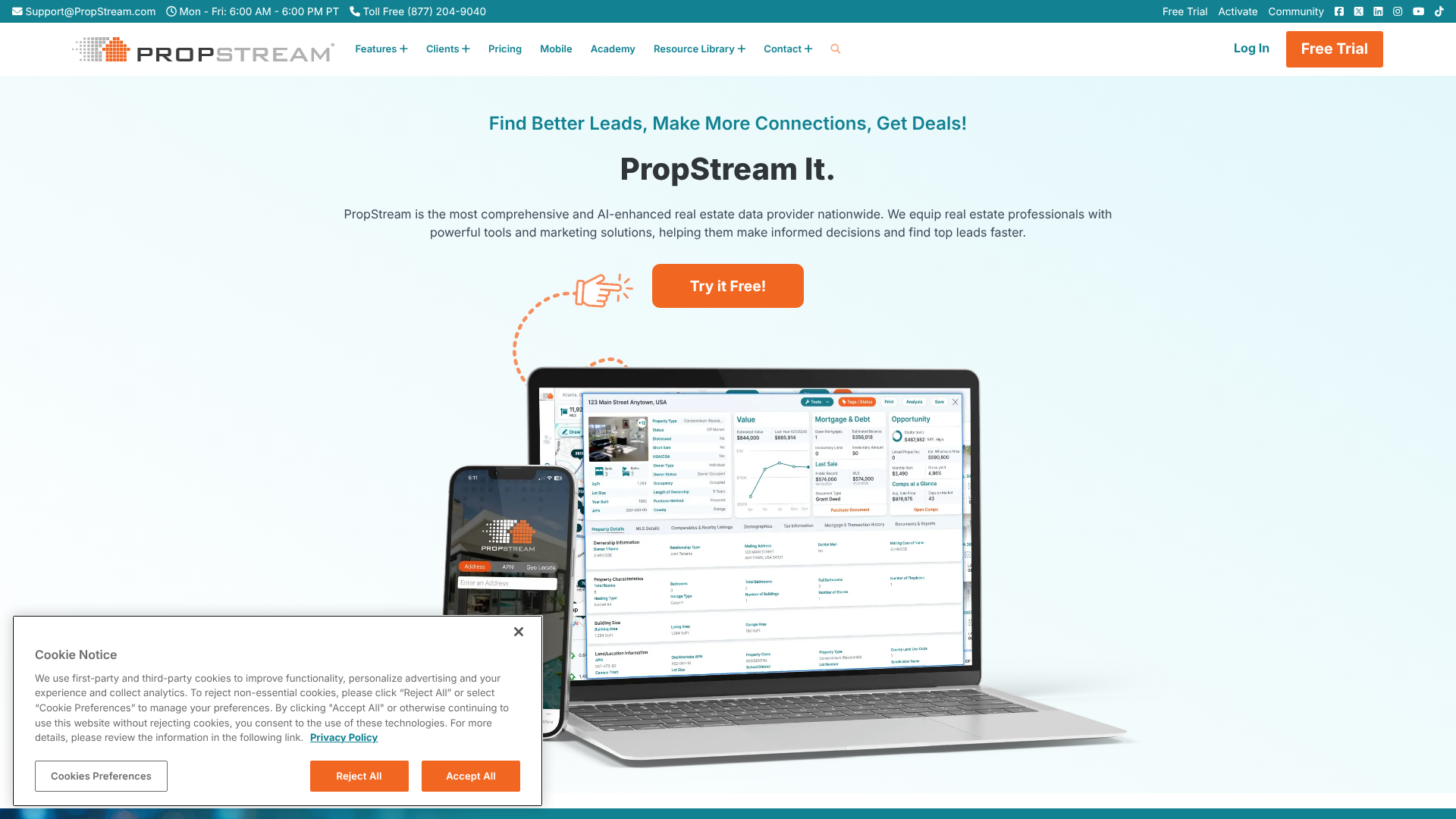
PropStream is a favorite among flippers, wholesalers, and investors focused on acquisition. Its strength lies in its massive database of property information across the U.S. You can filter for highly specific lead types, like properties with tax liens, pre-foreclosures, or out-of-state owners.
- Pros: Unmatched lead generation capabilities, built-in skip tracing and marketing tools, and access to MLS comps for accurate valuations.
- Cons: Can be overwhelming for new users due to the sheer amount of data. It is not a property management tool.
For Rental Property Accounting: Stessa
Stessa is designed for buy-and-hold investors who need a simple, effective way to track the financial performance of their rental properties. It's known for its user-friendly interface and powerful reporting. You can link bank accounts and credit cards to automate expense tracking.
- Pros: The core product is free, provides excellent financial dashboards and tax-ready reports, and is very easy to set up and use.
- Cons: It's not a full-service property manager (e.g., it doesn't handle tenant communication or maintenance requests directly). It's primarily an accounting and reporting tool.
For Scaling Portfolios & Syndication: AppFolio Investment Manager
For investors managing larger portfolios, raising capital, or running syndications, a more powerful solution is needed. AppFolio Investment Manager is designed for this level of complexity. It combines property management with a sophisticated investor portal, capital call management, and distribution calculations.
- Pros: All-in-one platform for property and investment management, professional investor portal builds credibility, and automates complex financial distributions.
- Cons: Significantly more expensive than other options and is overkill for investors with just a few properties.
Understanding Pricing and Total Cost of Ownership
The price of investor real estate tools can vary dramatically, so it's essential to understand the different pricing structures and what you're actually paying for. A low monthly fee might look appealing, but hidden costs can quickly add up, impacting your overall return on investment.
Common pricing models include:
- Monthly Subscription (SaaS): This is the most common model. You pay a flat monthly or annual fee for access to the platform. Tiers are often based on the number of users, properties, or feature sets. PropStream, for example, uses this model.
- Freemium: Some platforms, like Stessa, offer a core set of features for free, with the option to pay for premium add-ons or services. This is an excellent way for new investors to get started without a significant upfront cost.
- Per Unit / Per Month: This model is common for property management software. The cost is calculated based on the number of units you manage. It's a scalable model that grows with your portfolio. AppFolio often uses this structure.
Beyond the subscription fee, be aware of potential hidden costs. Many deal-finding platforms charge extra for services like skip tracing, direct mail marketing, or pulling additional property documents. When evaluating software, create a list of all the features you need and confirm whether they are included in the base price or will incur extra charges. The goal is to find a tool that provides the most value for your specific needs without breaking your operational budget.

Pros and Cons of Using Specialized Software
Adopting a specialized software platform is a significant step for any real estate investor. While the benefits are substantial, it's important to have a balanced perspective and understand the potential downsides before committing.
The Advantages
- Data-Driven Decisions: The biggest advantage is moving from guesswork to data-backed choices. Software provides access to market trends, accurate comps, and financial models that reduce risk and improve your chances of picking a winning property.
- Increased Efficiency: Automation is a huge time-saver. Tasks that used to take hours—like pulling lead lists, sending marketing materials, or compiling expense reports—can be done in minutes. This frees you up to focus on high-value activities like negotiating deals and building relationships.
- Scalability: As your portfolio grows, managing it with spreadsheets becomes nearly impossible. Software provides the infrastructure to scale your business efficiently without getting bogged down in administrative tasks.
- Professionalism: Using a dedicated platform enhances your credibility with lenders, partners, and private money investors. Professional reports and a streamlined process show that you run a serious, well-managed operation.
The Potential Drawbacks
- Cost: Specialized software is an ongoing business expense. For investors just starting, a monthly subscription fee can be a significant financial commitment.
- Learning Curve: Even the most user-friendly platforms require an investment of time to learn. You'll need to dedicate several hours to setting up your account, importing data, and mastering the key features.
- Over-Reliance on Data: While data is powerful, it doesn't replace on-the-ground due diligence. It's easy to get "analysis paralysis" or trust the numbers so much that you neglect to visit the property or understand the nuances of a neighborhood.
Pro Tip: To mitigate the learning curve, look for software companies that offer excellent customer support and training resources. A robust knowledge base, video tutorials, and live webinars can dramatically speed up your onboarding process and help you get the most out of your investment.
FAQ: Answering Your Top Questions
Here are answers to some of the most common questions new and experienced investors have about real estate software.
What is the best software for small real estate investors?
For small real estate investors, especially those with just one or a few rental properties, the best software is often one that is free or low-cost and focuses on the essentials. Stessa is an excellent starting point for rental property owners because its core financial tracking and reporting features are free. This allows you to organize your finances professionally from day one without any cost.
If you're focused on finding your first or next deal, a lower-tier subscription to a tool like PropStream or a competitor can be a worthwhile investment. However, before paying for any software, a small investor should first master free tools like the rental property calculators available on sites like BiggerPockets to understand the fundamentals of deal analysis.
What is the 3 3 3 rule in real estate?
The 3-3-3 rule is a guideline used primarily by house flippers to quickly assess the viability of a potential project. It's not a hard-and-fast law but a rule of thumb to manage risk.
- 3 Months to Renovate: Aim to complete the entire renovation within three months. The longer the project takes, the more holding costs (insurance, taxes, loan payments) you'll incur.
- 3 Months to Sell: Budget for three months to list, market, and sell the property after renovations are complete.
- 3% for Closing Costs & Buffer: Allocate 3% of the After Repair Value (ARV) for your closing costs when you sell, and maintain an additional financial buffer for unexpected issues during the renovation.
Which property app is best for investors?
The "best" property app depends entirely on the investor's strategy. There is no single app that is best for everyone.
- For deal finding on the go, the PropStream mobile app is very powerful for looking up properties and running comps in the field.
- For managing rental properties, apps from services like Stessa or Baselane allow you to track expenses and view portfolio performance from your phone.
- For general market research, apps like Zillow and Redfin are still useful for quickly checking listings and recent sales, though their valuation estimates should be taken with a grain of salt.
What is the 7% rule in real estate?
The 7% rule is another rule of thumb, used by some buy-and-hold investors to quickly screen potential rental properties. It states that your total annual operating expenses (excluding the mortgage payment) will be approximately 7% of the property's value. This is a very rough estimate intended to be used for initial screening only.
For example, on a $200,000 property, the rule suggests you should budget around $14,000 per year (or $1,167 per month) for expenses like property taxes, insurance, maintenance, vacancy, and property management. A more common and reliable guideline is the 50% Rule, which states that operating expenses will be about 50% of your gross rental income.
Final Thoughts
Investing in real estate software is no longer a luxury; it's a critical component of building a successful and scalable investment business. By moving beyond spreadsheets, you gain a significant competitive advantage, enabling you to find better deals, analyze them more accurately, and manage your portfolio with greater efficiency.
The key is to avoid getting distracted by flashy features and instead focus on your core needs. Start by clearly defining your investment strategy and identifying the biggest bottlenecks in your current process. Whether you need to generate more leads, streamline your accounting, or manage investor relations, there is a tool designed to solve your specific problem.
Use the free trials, watch the demos, and choose a platform that feels intuitive to you. The right real estate software for investors will pay for itself many times over, not just in financial returns, but in the most valuable asset of all: your time.