








Real Estate Software for Investors: A Buyer's Guide (2026)
Gone are the days of managing a real estate portfolio with scattered spreadsheets and paper files. To succeed in today's competitive market, you need efficiency, data, and speed. The right real estate software for investors provides all three, transforming how you find, analyze, and manage properties. These platforms are no longer a luxury; they are essential tools for making smarter decisions and maximizing your return on investment.
Whether you're flipping your first house or managing a portfolio of 100 rental units, the right technology stack can automate tedious tasks, uncover hidden opportunities, and give you a clear view of your financial performance. This guide will walk you through everything you need to know to select the perfect software for your specific investment strategy.
What You'll Learn
- Identify Core Needs: The most effective software aligns with your specific investment strategy, whether it's flipping, wholesaling, or buy-and-hold rentals.
- Key Features Matter: Look for essential functions like deal analysis calculators, lead generation databases, CRM capabilities, and property management dashboards.
- Software Categories: Investor tools are typically specialized for different stages, including finding deals (e.g., PropStream), analyzing them (e.g., DealCheck), and managing them (e.g., Stessa).
- Cost vs. Value: The goal isn't to find the cheapest tool, but the one that provides the highest return by saving you time or preventing costly mistakes.
- Start Small and Scale: Begin by solving your biggest bottleneck with a single tool, then integrate others as your portfolio and needs grow.
What to Consider Before Choosing Real Estate Software
Selecting a software solution is a significant decision that impacts your workflow and profitability. Before you start comparing features and pricing, take a step back to assess your foundational needs. A clear understanding of your goals will prevent you from investing in a tool that is either too simple or overly complex for your operations.
First, define your primary investment strategy. The ideal software for a house flipper is vastly different from what a long-term rental investor needs. A flipper requires tools for quick deal analysis, rehab budget tracking, and managing contractor contacts. In contrast, a landlord needs robust property management software for investors that handles rent collection, maintenance requests, and tenant screening.
Next, evaluate your current processes and identify the biggest pain points. Are you spending too much time manually searching for off-market deals. Is tracking expenses across multiple properties a nightmare during tax season. Pinpointing your main bottleneck helps you prioritize which type of software will deliver the most immediate impact.
If lead generation is your weakness, a data and marketing platform is your priority. If you're drowning in administrative tasks for your rentals, a property management system should be your first investment.
Finally, consider your budget and scalability. While many powerful tools come with a monthly subscription, several free or low-cost options can be effective for new investors. It's also important to choose a solution that can grow with you. A platform that works for one property should ideally be able to scale to manage ten or fifty without forcing you to migrate to an entirely new system.
Key Features of Top Real Estate Software for Investors
Navigating the market for investor real estate tools can be overwhelming, with platforms offering a wide array of features. To simplify your search, focus on the core functionalities that drive the investment lifecycle: finding, analyzing, funding, and managing properties. The best software excels in one or more of these key areas.



Deal Analysis and Financial Calculators
This is the bedrock of any investment decision. Look for software that includes built-in calculators for essential metrics like Cash on Cash Return (CoC), Capitalization Rate (Cap Rate), Return on Investment (ROI), and Annualized Return. These tools allow you to plug in numbers for purchase price, rehab costs, rent estimates, and operating expenses to instantly see if a deal meets your criteria. This saves hours of manual spreadsheet work and reduces the risk of calculation errors.

Lead Generation and Property Data
Profitable deals often come from finding properties before they hit the mainstream market. Software with robust lead generation features gives you access to extensive databases of properties, including pre-foreclosures, tax delinquencies, and absentee owners. Look for features like list filtering, skip tracing (to find owner contact information), and direct mail marketing capabilities to streamline your outreach to motivated sellers.
CRM for Managing Contacts and Deals
As an investor, you're constantly building relationships with sellers, buyers, agents, lenders, and contractors. A Customer Relationship Management (CRM) system is vital for keeping these contacts organized. An investor-focused CRM helps you track leads through your deal pipeline, set follow-up reminders, and manage communications. Platforms like Trof AI use artificial intelligence to help identify and nurture high-potential leads, ensuring you never miss an opportunity.
Property Management Dashboards
For buy-and-hold investors, this is non-negotiable. Property management software automates the day-to-day tasks of being a landlord. Key features include online rent collection, maintenance request tracking, tenant screening, lease management, and expense tracking. This centralizes all property-related information, providing a clear overview of your portfolio's performance.
Transaction and Document Management
Closing a real estate deal involves a mountain of paperwork. Transaction management software helps organize documents, collect electronic signatures, and ensure compliance with legal requirements. A tool like Dotloop creates a centralized digital workspace where you, your agent, and the title company can collaborate efficiently to close the deal faster and with fewer hiccups.
A Comparison of Popular Real Estate Investment Software
No single software platform does everything perfectly for every investor. The market is segmented into specialized tools that excel at different stages of the investment process. Understanding these categories will help you build a tech stack that fits your business like a glove.
Here's a breakdown of the main types of real estate investment software and popular examples in each category.

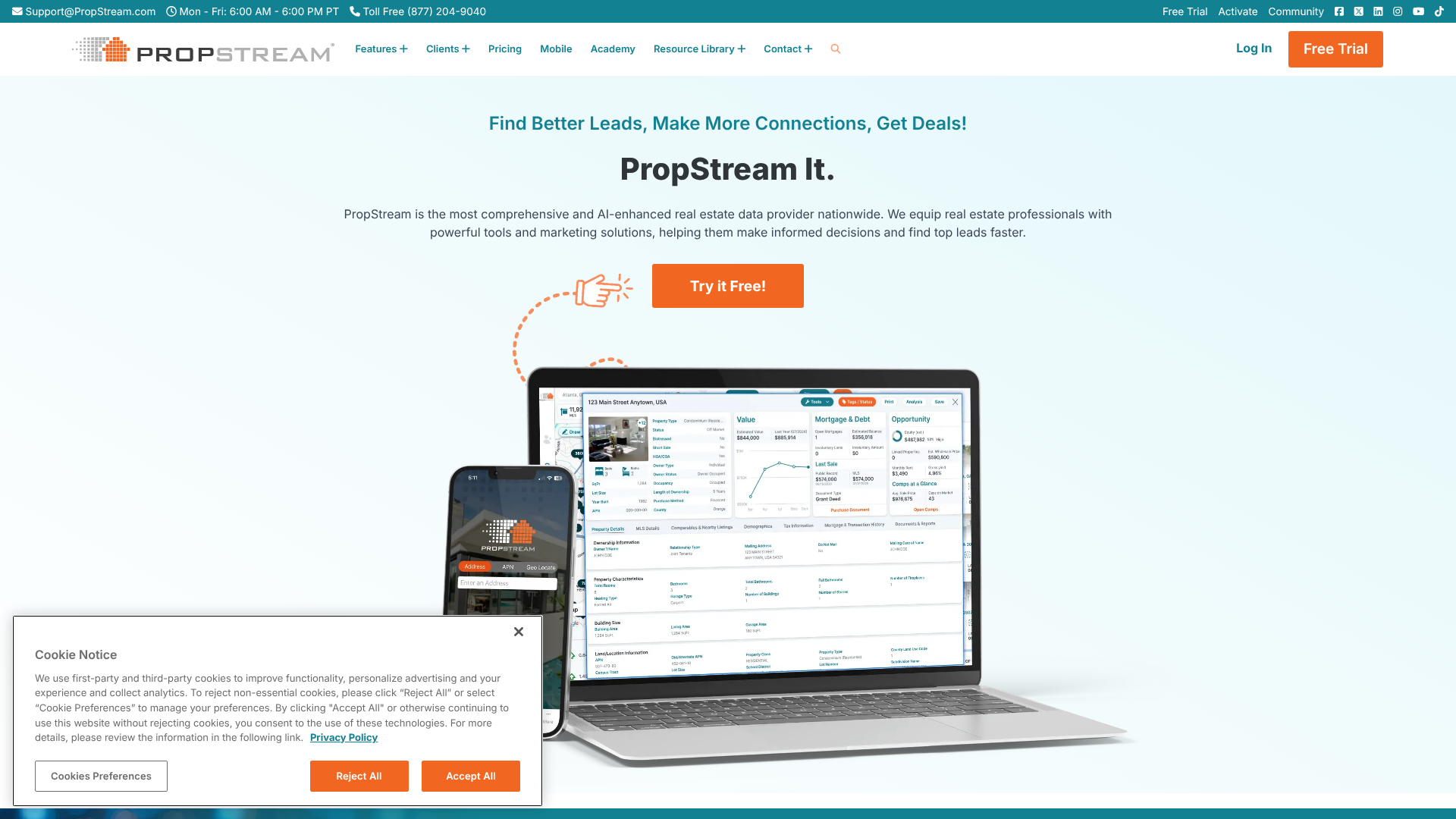
Category 1: Deal Finding & Data Platforms
These tools are designed to help you find investment opportunities, particularly off-market deals. They provide access to vast property databases and marketing tools. * Example: PropStream. It's known for its comprehensive data, allowing you to pull lists of properties based on dozens of criteria (e.g., high equity, absentee owner, vacant).
It also includes skip tracing and marketing features. * Best for: Wholesalers, flippers, and any investor focused on proactive lead generation.
Category 2: Deal Analysis & Valuation Tools
Once you have a potential property, these tools help you run the numbers quickly and accurately.
- Example: DealCheck. It offers detailed analysis for flips, rentals, and BRRRR deals. You can input property details and get instant projections for cash flow, ROI, and profit, complete with professional-looking reports to share with partners or lenders.
- Best for: New and experienced investors who want to validate deals with solid financial modeling.
Category 3: Property Management Software
These platforms are for buy-and-hold investors who need to manage tenants, maintenance, and finances for their rental properties.
- Example: Stessa. It's a free asset management tool designed for rental owners. It allows you to link bank accounts to automatically track income and expenses, organize documents, and monitor your portfolio's performance from a single dashboard.
- Best for: DIY landlords with one to twenty properties who need a simple way to organize their finances for tax time.
Category 4: Investor CRMs & Marketing Automation
These systems are built to manage your relationships and marketing efforts, helping you convert leads into closed deals.
- Example: Trof AI. This platform stands out by using AI to analyze data and predict which property owners are most likely to sell. It combines CRM functionality with powerful lead enrichment, helping you focus your marketing budget on the most promising prospects.
- Best for: Investors who want to build a scalable, data-driven system for finding and nurturing seller leads.
How Software Enhances Property Management for Investors
For investors focused on building a portfolio of rental properties, effective management is the key to long-term profitability and passive income. Juggling tenant communications, rent payments, and maintenance issues across multiple units can quickly become a full-time job. This is where dedicated property management software for investors becomes indispensable, turning chaotic tasks into streamlined, automated workflows.
The most immediate benefit is automated rent collection. Instead of chasing down checks, these platforms allow tenants to pay online via ACH transfer or credit card. Many systems can also send automatic reminders for upcoming rent and apply late fees according to your lease terms. This simple feature drastically improves cash flow consistency and reduces uncomfortable conversations with tenants.
Maintenance management is another area where software provides immense value. Tenants can submit repair requests through an online portal, complete with photos and descriptions. You can then track the status of each request, assign it to a contractor, and communicate updates to the tenant all within the platform. This creates a documented record of all maintenance issues, which is crucial for both liability and budgeting.
Furthermore, these tools simplify the financial side of property ownership. They track every dollar of income and categorize every expense, from mortgage payments to plumbing repairs. At the end of the year, you can generate profit and loss statements and other financial reports with a single click, making tax preparation significantly less stressful. This level of organization gives you a real-time pulse on the financial health of each property and your portfolio as a whole.
The Role of Analytics in Real Estate Investment Software
Modern real estate investment software does more than just organize information; it transforms raw data into actionable intelligence. The analytics features built into these platforms empower you to make decisions based on objective metrics rather than gut feelings. This data-driven approach is what separates amateur investors from professional operators.
One of the most powerful applications of analytics is in portfolio performance tracking. A good software dashboard will present you with key performance indicators (KPIs) at a glance. You can instantly see your overall portfolio value, total cash flow, occupancy rate, and return on equity. By drilling down into individual properties, you can identify which assets are performing well and which ones might be underperforming, prompting a closer look at rent levels or operating expenses.
Analytics also play a crucial role in market analysis. Many platforms integrate with public records and MLS data to provide sophisticated Comparative Market Analysis (CMA) reports. You can analyze recent sales of similar properties to determine an accurate after-repair value (ARV) for a potential flip or set a competitive rental rate for a new acquisition. Some advanced tools even use predictive analytics to forecast market appreciation or identify neighborhoods with high rental demand.
Pro Tip: Use the analytics in your software to run stress tests on potential deals. For example, model how a 10% vacancy rate or an unexpected $5,000 repair would impact your cash flow and overall returns. This helps you understand the true risk of an investment and build conservative projections.
Integrating Investor Real Estate Tools with Your Financial Stack
Your real estate software shouldn't exist in a silo. To achieve maximum efficiency, it needs to communicate with the other financial tools you use to run your business. Seamless integration creates a single source of truth for your financial data, eliminates redundant data entry, and provides a holistic view of your business health.
Many modern investor real estate tools are designed with integration in mind. The most common and valuable integration is with your bank accounts and credit cards. Platforms like Stessa can connect directly to your financial institutions, automatically importing and categorizing transactions. This means every rent deposit, mortgage payment, and trip to Home Depot is captured without you lifting a finger.
Integration with dedicated accounting software like QuickBooks or Xero is another critical feature. While many property management platforms have strong financial reporting, a full-fledged accounting system is often necessary for more complex businesses, especially those with employees or multiple legal entities. A direct integration allows your property-level data to flow into your main accounting system, simplifying bookkeeping and providing your accountant with clean, organized data.
Beyond direct integrations, look for platforms that offer an open API or connect with services like Zapier. This allows you to create custom automated workflows between your real estate software and thousands of other apps. For example, you could create a "Zap" that automatically adds a new tenant's contact information from your property management software to your email marketing list or a CRM like Wise Agent.
What Real Investors Say: User Reviews and Case Studies
Software features on a website are one thing, but real-world application is what truly matters. Learning how other successful investors use these tools can provide invaluable insights and help you visualize how they might fit into your own business. Forums and online communities are goldmines of honest feedback.
One common sentiment shared in a Reddit discussion on r/realestateinvesting is the importance of starting simple. Many experienced investors advise beginners not to get bogged down by complex, all-in-one systems. Instead, they recommend identifying their single biggest challenge—be it finding deals or tracking expenses—and choosing a best-in-class tool for that one job.
Case Study 1: The House Flipper
Sarah is a full-time house flipper who completes 8-10 projects per year. Her biggest challenges are finding undervalued properties and managing rehab budgets. She uses PropStream to identify and market to absentee owners in her target zip codes. Once she has a property under contract, she uses DealCheck to create a detailed rehab budget and project her profit margin. This combination allows her to systematize the two most critical parts of her business: acquisition and analysis.
Case Study 2: The Long-Distance Landlord
Mark owns a portfolio of five single-family rentals in a city three hours away. His primary challenge is remote management. He uses Stessa to get a high-level financial overview of his portfolio each month. For day-to-day operations, he uses a property management platform that gives his tenants an online portal to pay rent and submit maintenance requests. This tech stack gives him the confidence to manage his properties effectively from a distance, saving him countless hours on the road.
The Future of Real Estate Software: AI and Automation
The technology powering real estate investing is evolving at a rapid pace. What seems advanced today will be standard tomorrow. The most significant trend shaping the future of real estate investment software is the integration of artificial intelligence (AI) and machine learning. These technologies are moving beyond simple automation to provide predictive insights that were once unavailable to the average investor.
AI-driven deal sourcing is becoming increasingly sophisticated. Instead of just filtering lists based on static criteria, AI algorithms can analyze thousands of data points—including property characteristics, owner demographics, and market trends—to predict which properties are most likely to sell soon. Platforms like Trof AI are at the forefront of this movement, helping investors focus their time and marketing dollars with unprecedented accuracy.
Automation will continue to deepen its roots in property management. Smart home technology integrated with management software will allow for predictive maintenance, alerting landlords to a potential furnace failure before it happens. AI-powered chatbots will handle routine tenant inquiries 24/7, freeing up property managers to focus on higher-value tasks.
In the long term, technologies like blockchain could streamline transactions by creating a secure, transparent, and immutable record of property ownership, potentially making title insurance and lengthy closing processes obsolete. While widespread adoption is still years away, staying aware of these trends will help you adapt and maintain a competitive edge.
Cost-Benefit Analysis: Is the Software Worth the Price?
When evaluating real estate software, it's easy to get sticker shock from monthly subscription fees. However, it's crucial to frame the cost not as an expense, but as an investment. The right tool should generate a return far greater than its price, either by saving you time, increasing your revenue, or helping you avoid costly mistakes.
Consider the value of your time. If a $99/month subscription saves you ten hours of manual work each month, and you value your time at $50/hour, the software is generating a net return of $401 every month. This is time you can reinvest into higher-value activities like negotiating deals, raising capital, or analyzing new markets.
More importantly, consider the cost of a single bad deal. A mistake in your ARV calculation or an overlooked expense could cost you tens of thousands of dollars. If a $50/month deal analysis tool helps you avoid just one unprofitable project over its lifetime, it has paid for itself hundreds of times over. The confidence and accuracy these tools provide are a form of insurance against devastating financial errors.
When starting, don't be afraid to use free tools. Platforms like Stessa and the free calculators on BiggerPockets offer immense value at no cost. As your portfolio grows and your needs become more complex, you can strategically upgrade to paid subscriptions that solve specific, high-value problems in your business.
Best Practices for Choosing and Implementing Your Software
Selecting the right software is only half the battle; successful implementation is what unlocks its true value. A thoughtful approach to choosing and adopting new technology will ensure it becomes a helpful asset rather than a frustrating burden.
-
Always Start with a Free Trial: Never commit to a long-term subscription without testing the software first. Most reputable companies offer a free trial period (typically 7 to 30 days). Use this time to explore the user interface, test the core features, and see if the workflow feels intuitive to you. If you find yourself struggling to navigate the platform during the trial, it's unlikely to become an integral part of your business.
-
Focus on One Core Function: Resist the temptation to adopt a massive, all-in-one system that promises to solve every problem at once. This often leads to overwhelm and underutilization. Instead, identify your single biggest pain point and find the best tool to solve that one problem. Once you've mastered that platform and integrated it into your daily routine, you can then look for the next tool to solve your next biggest problem.
-
Prioritize User-Friendliness and Support: A powerful tool is useless if you can't figure out how to use it. Look for software with a clean, modern interface and plenty of educational resources, such as video tutorials, knowledge bases, and live webinars. Check reviews for feedback on the quality of customer support. When you inevitably run into a question or a technical issue, responsive and helpful support is invaluable.
Pro Tip: Before subscribing, send a pre-sales question to the software's support team. Their response time and the quality of their answer will give you a good indication of the level of service you can expect as a paying customer.
Frequently Asked Questions (FAQ)
What is the best software for a beginner real estate investor?
For a beginner, the best approach is to start with free, user-friendly tools that focus on the fundamentals. A great combination is using the free BiggerPockets Calculators for deal analysis to understand the numbers behind a potential investment. For tracking the finances of your first rental property, Stessa is an excellent free tool that automates income and expense tracking.
Is there free real estate software for investors?
Yes, there are several high-quality free options available. Stessa is a popular choice for free rental property finance tracking. The BiggerPockets Calculators are industry-standard for analyzing deals. While free tools may lack the advanced features of paid subscriptions, they are more than sufficient for investors who are just starting out and want to keep overhead low.
How does CRM software help real estate investors?
A CRM (Customer Relationship Management) system helps investors manage their most valuable asset: their network. It's used to track interactions with motivated sellers, cash buyers, private lenders, real estate agents, and contractors. By keeping all contact information, notes, and follow-up tasks in one organized place, a CRM ensures that no lead or important relationship falls through the cracks, leading to more closed deals.
What's the difference between investor software and agent software?
While there can be some overlap, the core functions are different. Agent software, like kvCORE or Follow Up Boss, is primarily focused on managing client relationships for buying or selling a primary residence, with features like MLS integration and client-facing property search portals. Investor software is built for analyzing the financial viability of properties as investments, finding off-market deals, and managing rental portfolios. The metrics and workflows are centered around profit, not just commission.
Final Thoughts
Choosing the right real estate software for investors is a critical step in professionalizing your operations and scaling your portfolio. The modern market demands speed, accuracy, and efficiency, and the right technology provides a significant competitive advantage. By moving beyond spreadsheets and manual processes, you free up your most valuable resource—your time—to focus on finding great deals and making smart decisions.
Start by clearly defining your investment strategy and identifying the most significant bottlenecks in your current workflow. Whether your biggest need is finding more leads, analyzing deals faster, or streamlining property management, there is a specialized tool designed to help. Begin with a single, high-impact solution, master it, and then thoughtfully build out your tech stack as your business grows.
For investors focused on building a predictable pipeline of off-market deals, leveraging a data-driven platform is a logical next step. A tool like Trof AI can help you pinpoint motivated sellers with greater accuracy, ensuring your marketing efforts yield the highest possible return. Ultimately, the best software is the one you use consistently to make better, more profitable investment decisions.