









What Is a Top Producer in Real Estate? An Agent's Guide to High Performance
You've seen the term on business cards, websites, and for-sale signs: "Top Producer." But what is a top producer in real estate, really. The term can be confusing because it refers to two different things: a high-performing agent and a popular software designed to help agents reach that status. A top producer is an agent who consistently closes a high volume of transactions and generates significant revenue, placing them in the elite tier of their local market.
There's no single, universal definition, but it's a title earned through exceptional sales performance, deep market knowledge, and an unwavering commitment to client success.
This guide breaks down both meanings of the term. We'll explore the characteristics and strategies that define a top-producing agent and examine the technology, like the well-known Top Producer CRM, that provides the systems needed to operate at that level. Whether you're an aspiring agent aiming for the top or a seasoned pro looking to systematize your success, understanding this concept is the first step toward building a dominant real estate business.
Quick Summary
- Dual Meaning: The term "top producer" refers to both a high-achieving real estate agent and a specific Customer Relationship Management (CRM) software designed for the industry.
- No Universal Standard: Being a top producer isn't a formal certification. It's a status based on performance metrics like Gross Commission Income (GCI) and transaction volume, which vary significantly by market.
- Key Traits: Top producers share common characteristics, including strong discipline, excellent communication skills, a client-first mentality, and a deep understanding of their local market.
- Systems are Crucial: Elite agents don't rely on luck. They use proven strategies for lead generation, networking, and client follow-up, often powered by technology like a dedicated real estate CRM.
- Technology as an Enabler: Software like Top Producer CRM helps agents implement the systems necessary for high performance by organizing contacts, automating marketing, and managing transactions efficiently.
The Definition: What is a Real Estate Producer?
A real estate top producer is an agent or broker who consistently ranks in the upper echelon of their market based on sales performance. Unlike a formal designation that requires a course or exam, this title is earned through results. It signifies that an agent closes a significantly higher number of deals or a greater total sales volume than the average agent in their area.
Because the term isn't standardized, its meaning can change from one brokerage or market to another. In a high-priced market like San Francisco or New York City, an agent might be considered a top producer for closing 20-30 deals a year. In a more affordable market, the benchmark might be 50, 75, or even over 100 transactions annually. Brokerages often create their own internal awards for their top 5% or 10% of agents, labeling them as members of the "President's Club" or "Chairman's Circle," which are all variations of the top producer concept.
Ultimately, the title serves as a marketing tool that communicates a history of success and experience to potential clients. It implies that the agent has a proven track record, strong negotiation skills, and the market expertise necessary to handle complex transactions effectively. For a buyer or seller, working with a top real estate producer can provide confidence that they are in capable hands.
The Hallmarks of a Top Real Estate Producer
While the numbers define their status, top producers are set apart by a specific set of personal and professional characteristics. These traits are the engine behind their impressive sales figures and are cultivated through discipline and intention. They go far beyond simply knowing how to fill out a contract; they are about building a sustainable and scalable business.
First and foremost is an unshakeable work ethic. Real estate is not a 9-to-5 job, especially for those at the top. Top producers are known for their dedication, often working long hours, weekends, and holidays to serve their clients and close deals. They are proactive, not reactive, and consistently focus on income-producing activities like prospecting and lead follow-up.



Another key characteristic is being hyper-organized and system-oriented. An agent juggling dozens of clients and transactions cannot afford to be disorganized. Top producers rely on proven systems for everything from lead management to client communication and transaction coordination. They understand that success is repeatable, and they build processes to ensure a consistent level of service and efficiency, which prevents details from falling through the cracks.
Finally, they possess exceptional communication and interpersonal skills. A top producer is a master at building rapport and trust. They listen intently to their clients' needs, provide clear and honest advice, and are skilled negotiators who can navigate difficult conversations to achieve the best outcomes. This client-centric approach is why so much of their business comes from referrals and repeat clients; they don't just sell houses, they build lasting relationships.


How Success is Measured: Key Metrics for Top Producers
The status of a "top producer" isn't just a feeling; it's backed by cold, hard data. Several key performance indicators (KPIs) are used across the industry to measure an agent's success and determine their ranking within a brokerage, local association, or the market at large. Understanding these metrics is crucial for any agent who wants to track their progress and set meaningful goals.
The most common metric is Gross Commission Income (GCI). This is the total amount of commission an agent earns before any splits with their brokerage, referral fees, or business expenses are deducted. GCI is a direct measure of the revenue an agent generates, making it a primary indicator of their production level. An agent with a high GCI is undeniably a top earner.
Another critical metric is transaction volume, which is simply the total number of properties an agent successfully helps a client buy or sell (referred to as "sides" or "units"). While GCI can be skewed by a few very high-priced sales, transaction volume demonstrates an agent's ability to consistently manage and close deals. An agent who closes 100 homes in a year is a powerhouse of activity and process management, regardless of the price point.
Lastly, there is sales volume. This is the total dollar value of all the properties an agent sold in a given period. For example, selling ten homes at an average price of $500,000 results in a sales volume of $5 million. This metric is often used for rankings in luxury markets, as it highlights an agent's expertise in handling high-value assets.
Top producers typically excel in at least two of these three areas, with the very best leading their markets in all three.
Does Experience Guarantee Top Producer Status?
It's a common assumption that the most experienced agents are always the top producers. While experience is incredibly valuable, it doesn't automatically guarantee a spot at the top. The real estate industry is dynamic, and success depends more on an agent's ability to adapt, systematize, and consistently execute than on the number of years they've held a license.
Experience certainly provides a significant advantage. A veteran agent has likely built a substantial sphere of influence (SOI) and a strong referral-based business, which is a reliable source of leads. They have also navigated numerous market cycles—from buyer's markets to seller's markets—giving them the wisdom to advise clients effectively in any condition. This deep market knowledge and a large database of past clients are powerful assets that can take years to build.
However, a newer agent with immense drive, a strong work ethic, and a mastery of modern technology can often outperform a more experienced but less systematic competitor. Today's top producers are often those who embrace new tools for lead generation, marketing automation, and client management. They aren't afraid to invest in systems that create efficiency and allow them to scale their business beyond what one person can handle alone.
A new agent who implements a powerful CRM from day one can build a well-organized database and follow-up system that rivals an agent with 20 years of experience but a messy, inconsistent process.
Pro Tip: Don't confuse years in the business with effectiveness. A highly focused agent in year three who uses a CRM to manage their pipeline can easily be more productive than a 15-year veteran who relies on sticky notes and memory.
A Local Game: Why "Top Producer" Varies by Region
The definition of a real estate top producer is not one-size-fits-all; it's intensely local. The benchmarks for what constitutes elite performance can vary dramatically from one city to another, and even between neighborhoods within the same metropolitan area. This variation is primarily driven by the median home price of the market.
Consider two different agents. Agent A works in a market where the average home price is $250,000. To achieve a sales volume of $10 million, they would need to sell 40 homes. Agent B works in a luxury market where the average home price is $2 million.
To reach the same $10 million sales volume, they only need to sell five homes. Both have achieved the same sales volume, but their transaction counts are vastly different. This is why local context is everything.
Real estate associations and brokerages recognize this disparity and set their award criteria accordingly. The Atlanta REALTORS® Association might require a minimum of $5 million in sales volume to qualify for its Top Producers club, while the Beverly Hills/Greater Los Angeles Association of Realtors might have a much higher threshold. Because of this, you can't directly compare an agent's production in Des Moines, Iowa, to one in San Diego, California, without considering the local market dynamics. A top producer is always defined relative to their peers in the same market.
The Playbook: Common Strategies of Elite Agents
Top producers don't achieve their status by accident. They operate like CEOs of their own businesses, employing a set of proven strategies to generate leads, nurture relationships, and close deals consistently. While their personalities and approaches may differ, their underlying business practices share common themes centered on discipline, leverage, and relentless follow-up.
One of the most fundamental strategies is time blocking. Top producers are masters of their calendars. They schedule specific, non-negotiable blocks of time for their most important activities, especially lead generation. Whether it's two hours of calling expired listings every morning or an hour dedicated to writing personal notes to their sphere of influence, this time is protected from distractions.
This ensures that prospecting, the lifeblood of their business, happens every single day.
Another core strategy is building a diversified lead generation plan. They don't rely on a single source for new business. A top producer's plan might include a mix of activities such as running targeted social media ads, hosting client appreciation events, networking with local business owners, and systematically asking for referrals from past clients. This multi-channel approach creates a predictable and steady flow of opportunities, insulating their business from fluctuations in any one lead source.
Finally, they are relentless about lead follow-up. The fortune is in the follow-up, and top producers live by this mantra. They understand that most leads are not ready to transact immediately. Using a CRM, they implement automated follow-up campaigns with emails, text messages, and task reminders to stay in touch with potential clients over weeks, months, or even years.
This long-term nurturing process ensures that when a lead is finally ready to buy or sell, they are the first agent that comes to mind.
The Tech Stack of a Top Producer: A Look at the Tools
Modern top producers are not just great salespeople; they are savvy business operators who use technology to create efficiency, scale their operations, and deliver a superior client experience. At the heart of their tech stack is a powerful Customer Relationship Management (CRM) system designed specifically for real estate. One of the most established and well-known names in this space is, fittingly, Top Producer.
What is Top Producer CRM?
Top Producer is a real estate CRM software that helps agents manage their leads, contacts, and transactions all in one place. It's designed to be the central hub for an agent's business, providing the tools needed to implement the systems and strategies used by high-performing agents. It turns a chaotic list of contacts and to-do items into an organized, automated machine for nurturing relationships and closing deals.
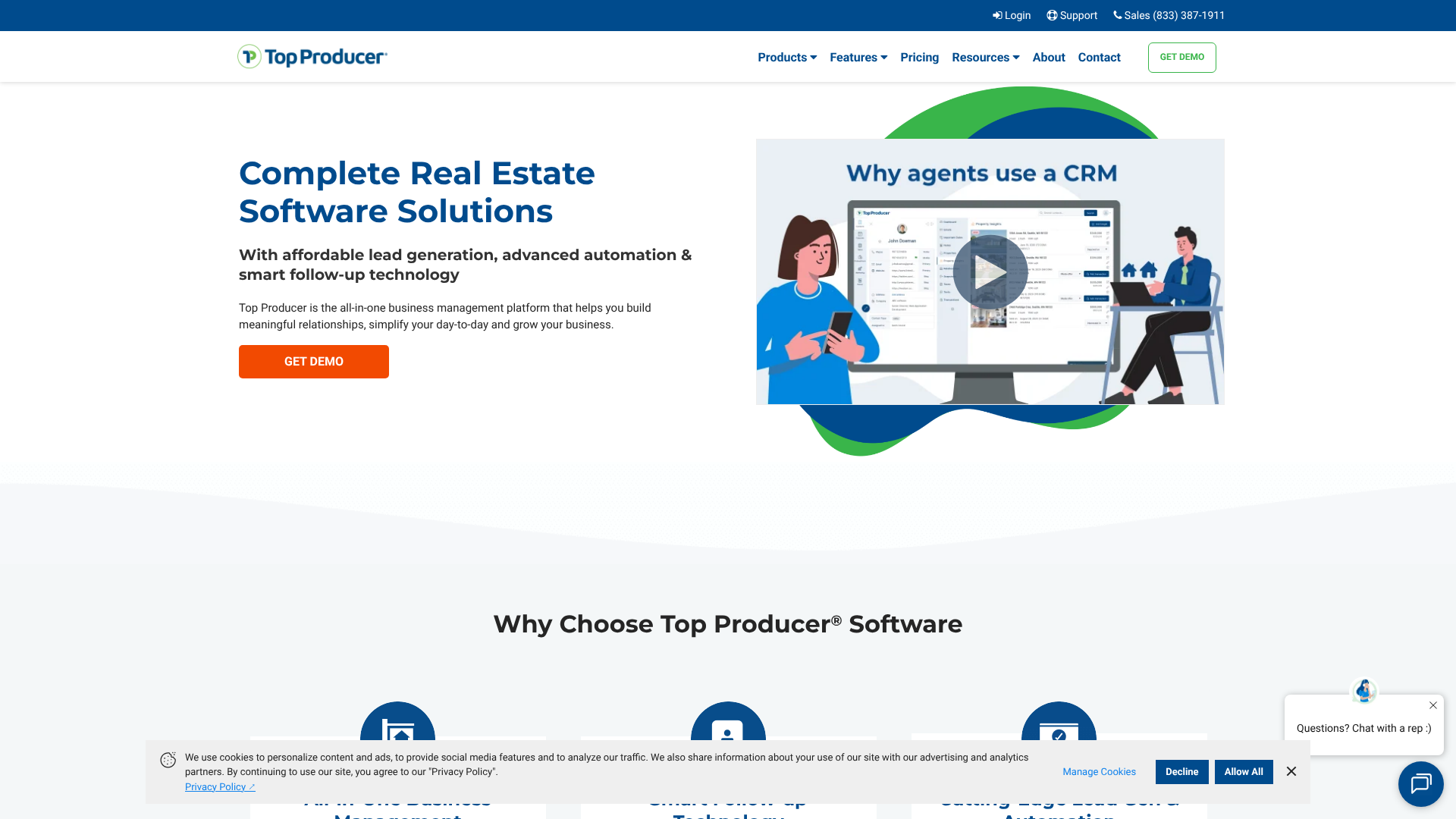
The platform helps agents solve one of their biggest challenges: consistent follow-up. With features like automated marketing campaigns, lead routing, and transaction management checklists, it ensures that no opportunity is missed and every client receives timely communication. By systematizing these critical tasks, it frees up the agent to focus on what they do best: building relationships and negotiating contracts.
Key Features of Top Producer CRM
- Contact Management: It provides a sophisticated database to organize all your contacts, from new leads to past clients and sphere of influence. You can categorize contacts, track conversations, and set follow-up reminders.
- Lead Incubation: The "Follow-up Coach" feature suggests daily activities to keep you in touch with your pipeline. It also offers automated email and text message campaigns to nurture long-term leads until they are ready to act.
- Marketing Automation: Top Producer includes a library of professionally designed email templates, newsletters, and marketing materials. You can set up drip campaigns to automatically send relevant content to different segments of your database.
- Transaction Management: Once you have a client under contract, you can apply transaction checklists to ensure every deadline is met and every document is in order. This helps streamline the closing process and reduce the risk of errors.
- MLS Integration: The system can connect to your MLS, allowing you to track your clients' favorite properties and see when new listings that match their criteria hit the market, providing valuable insights for follow-up.
Pros and Cons of Top Producer
Pros
- Comprehensive Feature Set: It's an all-in-one solution that covers nearly every aspect of an agent's workflow, from lead generation to post-closing follow-up.
- Established and Reliable: As one of the original real estate CRMs, it has a long history and a reputation for being a robust and dependable platform.
- Strong on Follow-Up: Its automated nurturing campaigns and daily task suggestions are excellent for ensuring consistent contact with a large database.
Cons
- Dated User Interface: Some users find the interface to be less modern and intuitive compared to newer competitors on the market.
- Learning Curve: With so many features, it can take time for a new user to learn the system and get it fully customized for their business.
For pricing information, it's best to visit the official website, as plans and packages can change. You can check current pricing on the Top Producer website.
Navigating the Tides: Market Trends and Their Impact
A top producer's success isn't just about their personal skills; it's also about their ability to adapt to ever-changing real estate market trends. The industry is constantly influenced by economic shifts, technological advancements, and evolving consumer behavior. Elite agents stay ahead of these curves, turning potential challenges into opportunities.
One major trend is the rise of digital marketing and social media presence. Gone are the days of relying solely on print ads and open houses. Today's top producers are digital mayors of their communities. They create valuable content—like neighborhood tours, market updates, and home-buying tips—on platforms like Instagram, YouTube, and Facebook.
This not only generates leads but also builds their personal brand and establishes them as the go-to expert in their area.
Another significant factor is fluctuating economic conditions, such as changes in interest rates and housing inventory. When interest rates rise, affordability becomes a major concern for buyers. A top producer pivots their strategy, educating clients on loan options like rate buydowns and focusing on the long-term value of homeownership. In a low-inventory market, they use their network to find off-market properties for their buyers, providing a solution that average agents can't.
Finally, the advancement of real estate technology continues to shape the landscape. From AI-powered lead nurturing to virtual tour software, new tools are constantly emerging. Top producers are early adopters. They don't see technology as a threat but as a tool for leverage.
They integrate these innovations into their existing systems to provide better service, work more efficiently, and gain a competitive edge.
Your Roadmap to Becoming a Real Estate Top Producer
Becoming a top producer in real estate is a marathon, not a sprint. It requires a clear vision, unwavering discipline, and the right systems to support your growth. If you're committed to reaching the top tier of the industry, here is a practical roadmap to guide your journey.
-
Define Your Niche and Brand: You can't be everything to everyone. Decide who you want to serve. Are you passionate about helping first-time homebuyers, working with luxury clients, or specializing in a specific neighborhood? Build your personal brand around this niche. Your marketing, content, and communication should all reflect your area of expertise.
-
Create a Detailed Business Plan: Treat your real estate career like a business from day one. Your plan should include specific, measurable goals for GCI, transaction volume, and sales volume. Break these annual goals down into quarterly, monthly, and weekly targets. Determine how many conversations, appointments, and contracts you need to hit those numbers.
-
Master One or Two Lead Generation Sources: Instead of trying to do everything at once, become an expert in one or two lead generation pillars first. Whether it's geographic farming, running Facebook ads, or hosting open houses, focus your energy until you have a consistent and predictable flow of leads. Once mastered, you can add another pillar.
-
Invest in a CRM Immediately: Don't wait until you're overwhelmed to get organized. Implement a real estate CRM like Top Producer from the very beginning. Use it to manage every contact and lead that comes into your world. A well-maintained database is your most valuable business asset and the key to long-term, sustainable success.
-
Commit to Lifelong Learning: The real estate industry is always changing, and the best agents are perpetual students. Invest in coaching, attend industry conferences, read books on sales and marketing, and network with other top agents. The more you learn, the more you can earn and the better you can serve your clients.
Frequently Asked Questions (FAQ)
What does top producer in real estate mean?
The term "top producer" in real estate signifies an agent who is among the highest performers in their specific market. This status is not a formal certification but rather a recognition of achieving a high level of sales, measured by metrics like Gross Commission Income (GCI), the number of homes sold (transaction volume), or the total dollar value of properties sold (sales volume). The specific benchmarks vary by location, but it consistently identifies an agent in the top 5-10% of their peers.
What makes you a top producer in real estate?
Becoming a top producer is the result of a combination of specific habits, skills, and systems. Key factors include a strong work ethic, exceptional organizational skills, and a deep understanding of the local market. Top producers are also masters of lead generation and follow-up, often using technology like a CRM to manage their client relationships at scale. Ultimately, it's their consistency in performing revenue-generating activities and providing excellent client service that elevates them above the average agent.
How much does a top producer real estate agent make?
The income of a top producer can vary dramatically based on their market's home prices and their business expenses, but it is significantly higher than the average agent. While a typical agent might earn between $50,000 and $100,000 per year, a top producer in a mid-sized market could earn anywhere from $250,000 to over $1 million in GCI annually. In high-cost luxury markets, the top agents can earn several million dollars per year.
How much does Top Producer cost?
The pricing for Top Producer CRM software varies depending on the specific plan and features included. They typically offer different tiers to suit individual agents, small teams, and large brokerages. Because pricing and packages are subject to change, the most accurate information can be found by visiting their official website. They often provide demos to showcase the platform's capabilities before you commit.
Is a producer the same as an agent?
In the context of real estate, the term "producer" is essentially a synonym for a licensed real estate agent or broker who is actively selling properties. The term is used to emphasize the agent's role in "producing" sales and revenue. So, while all producers are agents (or brokers), the term is often used to specifically describe those who are actively and successfully closing transactions, with "top producer" being the highest level of this.
Final Thoughts
Understanding what a top producer in real estate is means recognizing it as both a benchmark of success and a mindset built on systems and discipline. It's not a title given lightly but one earned through relentless effort, a deep commitment to clients, and the strategic use of technology to create leverage.
Whether you're just starting your career or looking to break through to the next level, the path is clear: define your goals, build repeatable systems, and never stop learning. Tools like the Top Producer CRM are designed to provide the technological backbone for these systems, helping you manage relationships and automate tasks so you can focus on what truly matters.
Ultimately, becoming a top producer is about more than just commission checks; it's about building a respected brand, becoming a trusted advisor in your community, and creating a business that provides lasting value to you and your clients.